Stop losing jobs to a missed call and a quote nobody followed up.
Most work is not lost to somebody cheaper. It is lost at ten to five on a Tuesday, when the phone rang while you had both hands full, and by the time you rang back they had already booked somebody who answered.
Work leaks out in three places. All three are silent.
Nobody rings to tell you they went somewhere else. That is exactly what makes these expensive: they never appear in a report, they never generate a complaint, and they feel like a quiet week rather than a problem you could fix.
-
The call you could not take
What happens todayIt goes to voicemail. They do not leave a message, because hardly anybody does any more. They tap the next result in the list and somebody else answers. You find out hours later, if at all.
What happens once this is inThey get a text back inside a minute, in your words, saying you are on a job and asking what they need. The conversation carries on by message while you finish what you are doing, and you ring when your hands are free.
-
The quote that went quiet
What happens todayYou send it. You hear nothing. You feel awkward about chasing, so you leave it a week, then another one, and after a fortnight you write it off in your head without ever asking.
What happens once this is inThree follow-ups go out on a schedule you set, in your voice, and stop the moment they reply or say no. Most quotes go quiet rather than getting refused, and those are two completely different things.
-
The enquiry that came in at 9pm
What happens todayIt sits in an inbox overnight, or over a weekend. By the time you open it they may well have asked two other people, and the one who answered first is already booked in.
What happens once this is inIt gets an immediate, honest reply telling them when you will come back to them properly, and it lands in one place with every other enquiry so it cannot quietly disappear.
One honest qualification on the third row. There is no Australian data on how many enquiries arrive out of hours, and the best available is American and from 2017 to 2018. It points the other way from the usual claim: 94% of calls to a typical business arrive Monday to Friday, with restaurants the exception at 51% after 5pm.4 So treat the evening enquiry as a real problem in some trades and an unproven one in most.
One phone call. Two endings.
One job, start to finish
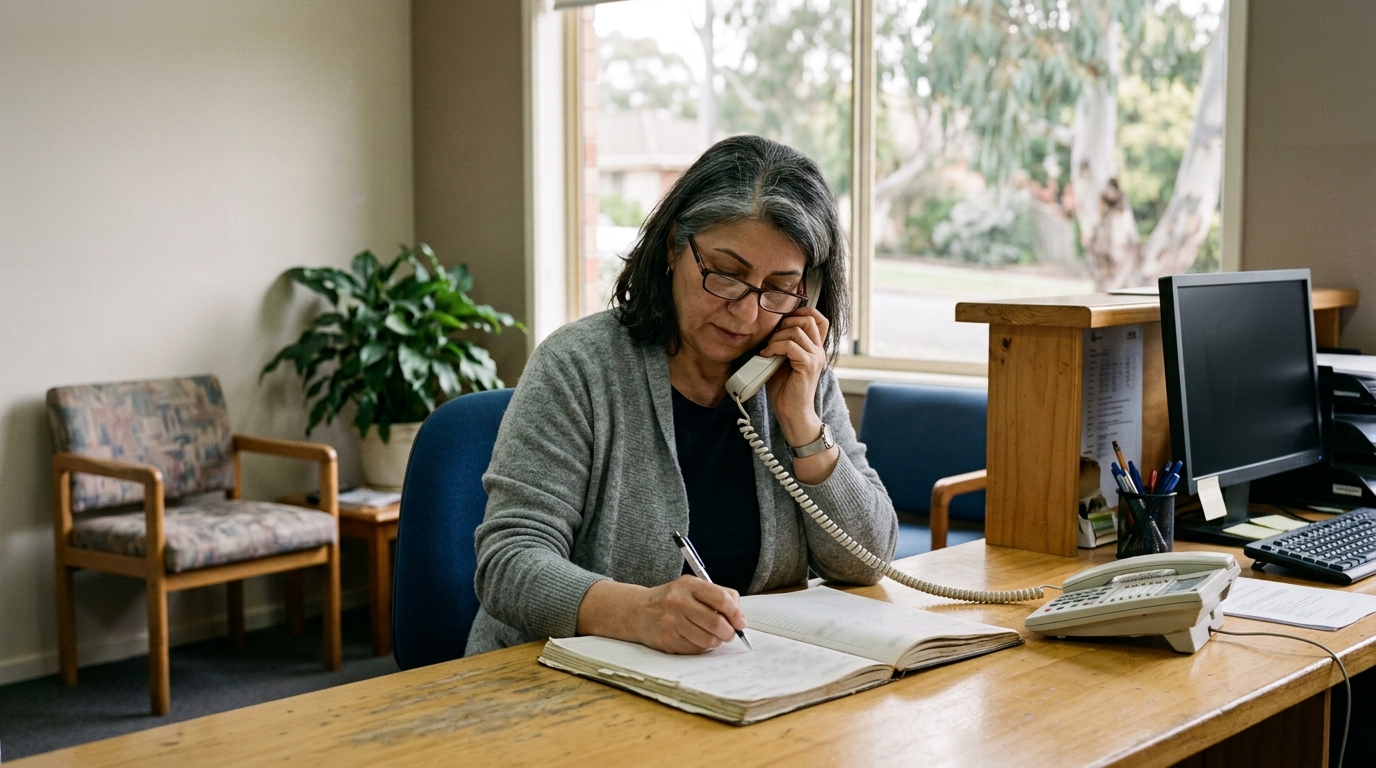
- 4.52pm The phone rings. You are under a sink with both hands full.
- 4.53pm It goes to voicemail. They do not leave one. Almost nobody does.
- 4.54pm They tap the next result. That business picks up.
- 7.20pm You see the missed call and ring back. It rings out.
- Never You find out what the job was worth.
Illustrative rather than measured. There is exactly one Australian dataset on how often calls get missed, it says 9.2%, and the figures you will have seen quoted are five to seven times higher and come from American vendors. All of that is set out further down, with sources.
Work out your own number.
The figure the industry quotes at you does not survive being checked, and the one Australian dataset that does exist says something five to seven times smaller. Both are set out beside the calculator, under its sources fold. In the meantime here is the arithmetic with your numbers in it rather than a survey’s, which is worth more anyway: your average job is not the industry’s average job.
What this number is, and what it is not
Arithmetic on three numbers you supplied. Not a benchmark, not a forecast, and not a promise. Nothing is sent anywhere and nothing is stored.
The rest of the story, with sources
It is a calculator rather than a claim because we went looking for the claim and it does not hold up. Here is what we found, so you can check us.
“62% of business calls go unanswered.” This one is everywhere, usually dressed as Australian. It traces to a United States local-search vendor, 2024, and a sample of 85 businesses spread across 58 industries, which is roughly one and a half businesses per industry. The page it came from no longer exists. Other versions of it trace to two American answering services and an AI receptionist company, none of which disclose a sample at all.1
The one real Australian figure is 9.2%. A Sydney agency analysed more than 207,000 inbound calls across 858 client businesses in nine industries and found an average call drop rate of 9.2%: flooring 17.9%, roofing 17.6%, pest control 5.1%, solar 1.8%.2 Two things to hold against it: these are one agency’s own clients, so businesses already doing marketing and already measuring their calls, and the underlying analysis is not published as a document anybody can audit. It is the best there is, and it is a long way from 62%.
“Ring back within five minutes and you are 21 times more likely to qualify a lead.” Real study, and not usable. It is from 2007, it was funded and written by a company selling software that rang leads back quickly, the sample was six companies, it was never peer reviewed, and the 21 times is five minutes against thirty minutes rather than against any normal delay. It also measures qualifying a lead, not winning the work.3
We would rather hand you the sum and let you argue with your own inputs than print any of that next to our name.
Sources + notes
- Traced 29 August 2026. The 62% figure traces to 411 Locals, a United States local-search vendor, 2024, 85 businesses across 58 industries; the cited page now redirects to the company homepage. The “85% never call back” and “62% contact a competitor” variants trace to PATLive and Dialzara, both American, neither disclosing a sample. One Australian site publishing a 22% to 47% missed-call rate cites ACMA, the ABS, the TIO, the OAIC and Standards Australia without linking a single report, dataset, date or sample, and ACMA and the ABS demonstrably hold no such data.
- Reported, not verified. AIIMS Group, reported by Dynamic Business, 28 August 2026. More than 207,000 inbound calls across 858 client businesses in nine industries. No date range is given for the calls and the underlying analysis is not published separately, so we have not been able to read the primary work.
- InsideSales.com Lead Response Management Study, 2007, authored and funded by the vendor, sample of six companies, never peer reviewed. The comparison is five minutes against thirty minutes and the outcome measured is lead qualification rather than sales. The Harvard Business Review article often cited alongside it, from 2011, does not contain five minutes, 21 times or 100 times anywhere; its figures are 7 times and 60 times, on different comparisons again.
- On after-hours enquiries specifically: no Australian data exists that we could find, and we looked at ACMA, the ABS, the telcos and the trade platforms. The best available is American, from BrightLocal across 45,264 businesses between September 2017 and December 2018, and it points the other way from the usual claim: 94% of calls to a typical business arrive Monday to Friday. Restaurants are the exception, at 51% after 5pm. So treat the evening-enquiry problem as real for some trades and unproven for most, which is how it is described above.
What Sell More actually is.
Four weeks, six pieces of work, all of it running in accounts and on a phone number you already own. Nothing here stops working the day you stop paying us.
What gets built
- Missed-call text backA missed call triggers a text within about a minute, from your number, written in the way you would actually say it.
The detail
Replies come back to a place your team already looks. Set up on your existing number, so nothing about how customers reach you changes.
- Quote follow-up that runs itselfA sequence of two or three follow-ups after a quote goes out, spaced the way you would space them, phrased the way you would phrase them.
The detail
It stops dead the moment somebody replies. You approve every word before it is ever sent.
- An after-hours answerEnquiries that arrive when you are asleep get an immediate acknowledgement that says something true, rather than pretending to be you.
The detail
Nobody is deceived, and nobody is left wondering for eleven hours whether the message went through.
- One place every enquiry landsCalls, forms, emails and messages collected in a single list with a status against each one.
The detail
Not a new system to learn: usually the tools you already pay for, connected so they stop being four separate inboxes.
- Consent recorded, properlyWhere each contact came from and what they agreed to, captured at the point they give it, because under Australian law you carry the burden of proving consent and a screenshot of a form six months later is not proof.
- The baseline, before anything changesEnquiries a week, how many get a reply, how long that takes, and how many quotes convert.
The detail
Recorded on day one, so what you see at 90 days is a comparison rather than a story.
The rules here are stricter than your software assumes.
Almost every AI marketing tool sold today was built around American law, where you may email somebody first and let them opt out afterwards. Australian law works the other way around. Under the Spam Act 2003 you need consent before the message goes out, and if anybody asks, the burden of proving you had it sits with you rather than with them. None of this is a reason not to do any of it. It is a reason to have it set up by somebody who has actually read the Act.
Latitude Finance, April 2026.7
TAB, July 2026.7
Lululemon, March 2026.7
The cap on a single day’s infringement notice. The caveats are below.
The multi-million totals are aggregates of many notices across many days.
The law starts from no, and the burden of proof is yours
The Spam Act does not say “get consent”. Section 16 prohibits sending a commercial electronic message outright, then provides consent as an exception to that prohibition. Section 16(5) then puts the evidential burden on whoever wants to rely on the exception. In ACMA’s plainer words: “Under the Spam Act, it’s up to you to prove that you have a person’s consent.”5
There are two kinds of consent, and one is narrower than you think
Express consent is a form, a tickbox, a phone call, or a conversation face to face. Inferred consent only applies where somebody has knowingly and directly given you their address and there is a provable, ongoing relationship. Publishing an address in public is expressly not enough: Schedule 2 clause 4(1) rules that out.5
Buying something from you is not consent to be marketed to
ACMA is explicit that inferred consent “does not cover sending messages after someone has just bought something from your business”. Its own worked example: a bank telling an existing customer about another savings account is fine. The same bank emailing them about insurance is not.
You cannot send a message asking for permission to send messages
ACMA’s words: “You cannot send an electronic message to ask for consent, because this is a marketing message.” The request for permission is itself the thing that needs permission, which catches out almost every list-cleaning exercise we are ever asked about.
An unsubscribe link that lands on a login screen is unlawful
This is the single most commonly broken rule in Australian marketing, and it is broken by design in most “manage your preferences” flows. Spam Regulations 2021 regulation 7(6) says using the unsubscribe address must not require the recipient to provide any personal information beyond the address the message went to, or to log in to an existing account or create a new one. It is the provision Telstra breached across more than 10.3 million messages.6
Five business days, and it is not where everybody says it is
The five-day rule is almost universally attributed to section 18. It is not in section 18, which contains no time limit at all. It sits in Schedule 2 clause 6, and it governs when a withdrawal of consent takes legal effect. ACMA states the practical version as honouring an unsubscribe “within 5 working days”, free, working for at least 30 days after the message was sent. Separately, section 17(1)(d) requires your own contact details in the message to stay valid for 30 days, which is the part most often missed.5
SMS is covered, and the Act never uses the word
Section 5(1)(b)(iii) catches any message sent to “a telephone account”, which is how text messages fall under the Spam Act, and (b)(ii) catches instant messages, which is how ACMA reached WhatsApp in a 2024 case. Section 5(5) expressly excludes voice calls. So the division is clean: text, email and instant messages sit under the Spam Act, and phone calls sit under a different Act entirely.
There is no existing-customer exemption for phone calls
Almost everybody believes there is. The Do Not Call Register Act 2006 exempts government bodies, registered charities, political parties, members of parliament, election candidates and educational institutions where the person is or was a student. That is the whole list. A customer relationship is relevant only through consent, and business numbers cannot be listed on the register at all.6
Telemarketing consent goes stale after three months
Schedule 2 clause 3 of the Do Not Call Register Act: where express consent is given without a stated period, it is taken to have been withdrawn three months later. Note the asymmetry, because it catches people out. Spam Act consent does not expire. Do Not Call consent does, by default, at three months. A lead who enquired last quarter, whose number is on the register, cannot lawfully be cold-called today unless the original consent said otherwise. Answering quickly is a compliance argument as well as a commercial one.6
This is enforced, and recently
Three actions this year alone. Latitude Finance paid AU$3.96 million in April 2026 after sending more than 2.3 million marketing messages without accurate contact information, 344,416 of which also had no working unsubscribe. TAB paid AU$2.76 million in July. Lululemon paid AU$702,900 in March for emails with no functional unsubscribe facility.7
The detail in the Latitude case is the one to notice, because it is exactly what an SMS follow-up tool does by default. In ACMA’s words: “While recipients were told they could reply ‘STOP’ to unsubscribe, many messages were not capable of being used in this way.”
Two honest caveats. Every action in 2025 and 2026 was against a large corporate, and none against a small business, so nobody should read this as a regulator hunting two-person shops. And what ACMA actually issues is an infringement notice, capped at 1,000 penalty units for a single day’s breaches, which is AU$364,000. The multi-million totals are aggregates of many notices across many days. The relevance to a business of six people is not the size of the penalty. It is that the conduct being penalised is the default behaviour of off-the-shelf tools.
- Cold email or SMS to a purchased list. No amount of warming up makes bought addresses consented ones.
- A message that asks somebody for permission to message them. That message is itself the breach.
- An unsubscribe that makes somebody log in, or asks them why they are leaving before it will work.
- Anything that texts a number lifted from a directory rather than given to you by the person who owns it.
If you text customers, your sender ID now has to be registered
The SMS Sender ID Register became mandatory on 1 July 2026. ACMA’s own words: “From then, text messages sent with unregistered sender IDs will have the sender ID replaced with the word ‘Unverified’. These messages will be grouped together in a single message thread on a phone. People will likely treat unverified messages as scams.”8
Read that again from the customer’s side. An unregistered business texting a customer in 2026 does not simply look unfamiliar. It is filed into the same thread as the scams, labelled Unverified, by the phone itself. There is also a prerequisite that catches small businesses out: to register against an ABN, the authorised contact or service-of-notice email on the Australian Business Register has to be current, and plenty are not.
ACMA publishes no fee for registration. Note the phrasing: no fee is published, which is not the same as a page saying it is free, and we are not going to upgrade one into the other. Checking and registering this is part of every Sell More engagement, because a follow-up system nobody trusts is worse than no follow-up system.
Sources + notes
- Spam Act 2003 (Cth), Compilation No. 10, authorised version C2016C00614, compilation date 10 March 2016, read in full from legislation.gov.au on 29 August 2026. Section 16 prohibition and evidential burden, section 17 sender information including the 30-day validity requirement, section 18 unsubscribe facility, Schedule 2 clause 4(1) on published addresses, Schedule 2 clause 6 on the five business days. Worth knowing: the Act has stood unamended for more than ten years.
- Spam Regulations 2021 (Cth), F2021L00285, commenced 1 April 2021, read in full. Regulation 7(6) is the login and personal-information prohibition. Plain-English restatements are ACMA’s, from Avoid sending spam, acma.gov.au, page last updated 29 November 2024. Do Not Call Register Act 2006 (Cth), Schedule 1 for the exemptions and Schedule 2 clause 3 for the three-month expiry of express consent.
- ACMA media releases and enforcement register, read 29 August 2026. Latitude Finance, 15 April 2026, AU$3,960,000, second action after AU$1.55 million in 2022. TAB, 22 July 2026, AU$2,758,800 across a telemarketing notice and a spam notice. Lululemon Athletica Australia, March 2026, AU$702,900, verified from ACMA’s register rather than a media release. Infringement-notice caps are Schedule 3 clause 5 of the Spam Act, at a penalty unit value of AU$364 for conduct on or after 1 July 2026.
- ACMA, About the register, acma.gov.au, page last updated 20 July 2026, read 29 August 2026.
What the tools underneath cost. You buy them, not us.
Every subscription is in your name, at retail, with no markup and no commission coming back to us. Here is the honest range, so you can see the fee is for the work rather than for hiding a margin on somebody else’s software.
- Text messages, on a gateway
- From about 3.7 cents a message on an Australian gateway at volume, before GST. A thousand texts is roughly AU$37 plus GST. Picture messages run far higher, around 19 to 34 cents. Read 29 August 2026.
- Text messages, inside a trade app
- Worth checking before you assume it is included. One mainstream Australian job-management app charges AU$0.20 a message on top of its per-user subscription, which is three to five times the gateway rate for exactly the same text. Over a year of follow-ups that is not a rounding error.
- Email to your own list
- Free up to 250 contacts on the mainstream platforms, then from about AU$18.27 a month. Anything a vendor quotes in US dollars is quoted in US dollars here as well, because converting it would hide that you are carrying the exchange rate.
- Whether GST is in the price
- Almost nobody makes this clear, so we do. Of the tools we priced for this page, exactly one publishes a GST-inclusive figure. Several state plainly that they are excluding it. The rest, including most of the American ones, say nothing at all, which means you find out on the invoice. Any comparison table without a GST column is misleading you.
- The ones that will not tell you
- Two of the best-known missed-call products sold into this market publish no price anywhere on their websites. That is a choice, and it tells you the number is negotiated rather than fixed. We will still price them for you if you want one, and we will say what we think of the number.
- The follow-up logic itself
- Usually built inside tools you already pay for rather than bought separately. Where a business genuinely needs something new, we say what it is and what it costs before you commit, and it stays in your name.
- What it costs to leave
- Nothing. There is no platform of ours in the middle of this. If you stop working with us, everything keeps running, because it was never running on anything of ours.
Every price above was read on the vendor’s own pricing page on 29 August 2026, and they move. GST treatment is reported exactly as the vendor reports it, and where a vendor says nothing about GST, that is what we say too.
How the four weeks run.
The fastest-acting piece goes first, deliberately, so you feel something working in week two rather than at the end. About three hours of your time in total.
- Week one
The free chat, then a scope you can hold us to
Half an hour about how work actually arrives at your business: what the phone does, what happens to a quote, who sees the emails. If we do not think we can help, we say so on the call. If we can, you get one page with what we will do, what it costs and what we will measure.
- Week two
Missed-call text back, live on your own number
The fastest thing to switch on and the one you feel first. Wording written with you, tested with whoever answers your phone, and running before anything else is touched. The baseline gets recorded in the same week.
- Week three
Quote follow-up + the after-hours reply
The follow-up sequence written in your voice and approved by you word for word before a single message goes out. Consent capture set up at the same time, because it has to be there from the first message rather than added later.
- Week four
Everything in one place, then your team takes over
Enquiries from every channel arriving in a single list. Then we sit with whoever runs your front desk until they can change the wording, pause a sequence and add a contact without ringing us.
- Day 90
The comparison
The same numbers measured the same way. If reply time did not move, or quotes did not convert any better, you hear that from us first along with what we think went wrong.
from AU$1,790
One off, not a retainer. No lock-in, no percentage of any job it wins, and no long contract. The final figure depends on how many channels enquiries arrive through and what we agree in the scope, and you see it in writing before you commit to a dollar.
Staying close afterwards is optional, from AU$149 a month, and you can stop it any time. We publish the price because being coy about money wastes the first phone call, and because a business that will not tell you what something costs until it has your number is telling you something.
What the AU$1,790 covers
Spelt out, so the word “from” is not doing any hiding.
- Missed-call text back live on your existing number
- A quote follow-up sequence, written with you and approved by you
- An after-hours acknowledgement that tells the truth
- Every enquiry landing in one place with a status
- Consent capture set up from the first message, not bolted on later
- Your team trained, and the baseline measured again at 90 days
More channels, a live voice agent, or a full CRM migration cost more and get priced before you commit rather than turning up on an invoice.
How you will know whether it worked.
Written down before we start and measured the same way at 90 days. Three of these four you almost certainly do not measure today, which is why the first month usually changes what an owner thinks is happening.
- Time to first reply
- From the enquiry arriving to somebody or something answering it. The single number this whole package exists to move, and the easiest one to check.
- Enquiries that get any reply at all
- Not the average. The share. An average reply time of two hours hides the three that got no answer at all, and those are the expensive ones.
- Quotes followed up
- How many of the quotes you sent actually received a follow-up. Almost nobody measures this before they start, and almost everybody is surprised by it.
- Quote-to-job conversion
- The share of quotes that turned into work, counted the same way at both ends. This one moves slowest and matters most.
- What we will not promise
- A conversion rate, a revenue figure, or a number of extra jobs. We can promise that every enquiry gets answered quickly. What people do next is theirs.
- The phone rings while you are on the tools, on a ladder, or with a customer in front of you
- You send quotes and do not always know what happened to them
- Enquiries arrive in the evening and get answered the next working day
- Somebody in the business is doing follow-up from memory, and it is going about as well as you would expect
- The phone barely rings. Fix that first, and Get Found is the page for it
- You are already at capacity and turning work away. More enquiries would make your week worse
- You want cold outbound to a bought list. We will not build it, and in Australia it is not a grey area
- You want a voice that answers the phone and passes as human. We think that is the wrong trade at this size, and we will say so
The questions people ask before the first call.
If yours is not here, ask it on the call. We would rather answer it than have you guess.
Is this an AI receptionist
Not in the sense of a voice that answers the phone and pretends to be a person. What we set up is text: a missed call gets an immediate written reply, and the conversation carries on by message. Voice agents that answer live calls exist and some are decent, but they are a bigger commitment, they go wrong more publicly, and most businesses of this size get more out of the text version for a fraction of the money. If you want the voice version we will tell you honestly what it involves.
Will it sound like a robot wrote it
Only if you approve wording that sounds like a robot wrote it, and you approve every word before anything sends. We write the first drafts by listening to how you talk about your own work. The test we use is whether your regulars would notice, and if they would, it is wrong.
What happens when somebody replies to the text
It comes back to a place your team already looks, and a human answers it. The automation covers the first sixty seconds, which is the part that decides whether you are still in the running. It does not run the conversation and it does not quote.
Can I just get the quote follow-up templates
You can, and we will give them to you free on the call if that is genuinely all you need. Templates are the easy half. The half that makes the difference is the follow-ups going out without you having to remember, and stopping the second somebody replies, which is the part a document cannot do.
Is texting my customers legal
It depends entirely on how they got onto the list, and the rules here are stricter than the ones most software assumes. Read the section above. Somebody who has just rung you has given you their number directly, which is the strongest position you can be in. A number scraped from a directory is the weakest. We set the consent capture up at the same time as the messaging, not afterwards.
What does it cost to run each month
The messages themselves, and they are cents. An Australian SMS gateway starts from about 3.7 cents a message plus GST, so a thousand texts is around AU$37 plus GST. Email to your own list is free to a few hundred contacts and from about AU$18 a month above that. You buy those directly, in your own name, at retail. We do not resell them.
What if the phone barely rings in the first place
Then this is the wrong package and Get Found is the right one, and you will hear that on the first call rather than after the invoice. There is no sense automating a reply to enquiries that are not arriving.
Answer the next one inside a minute.
Half an hour about how work reaches your business and where it goes missing. We will tell you what we would do, what it would cost, and whether the honest answer is that you should fix something else first.