AI news & hype
Is WordPress dead because of AI? No, but it's shrinking

Founder of Get AI Working
Published Facts checked
In short
No: WordPress is still the most used website system by a long way, and its latest version adds AI of its own. But its share of all websites has started to shrink, and more sites are now built without a website system at all. If your WordPress site works and you can update it, keep it.
You hear that AI can build a website in minutes. Your web person still says WordPress. Someone online says WordPress is finished.
If your business’s site runs on it, the worry is simple: are you paying to keep something that’s about to go stale?
The short answer is no. The longer answer is that the way websites get built is changing, and it’s worth knowing which way.
Is WordPress dying?
No. W3Techs, which tracks the software websites run on, still shows WordPress as the most used website system by a long way, on its figures for 3 November 2026.1
What has changed is the direction. WordPress’s share of all websites peaked at the start of 2025, and it has fallen further in 2026 than in any year since 2020.1 Over the same months, the share of websites built with no website system at all, which had fallen every year since 2020, has gone back up.1
WordPress isn’t dying, then, but it is shrinking while sites without a website system grow.
What does AI have to do with it?
Nobody has measured how much of the change is AI. W3Techs counts what a site runs on, not why its owner moved.1 Anyone who tells you the exact share is guessing.
What we can show is how it happens. Joost de Valk founded Yoast, a widely used search plugin (an add-on) for WordPress.
He ran his own blog on WordPress for years, then moved it to a site of plain pages with no website system, and wrote “I built this entire Astro site with AI assistance”.2 (Astro is a tool for building sites of plain pages.)
His summary: “People never wanted a CMS. They want a website.”2 (A CMS, or content management system, is the software you log in to so you can edit your site. WordPress is one.)
That’s the real shift for a small business. A site of plain pages used to need a developer for every change, which is why a system you could log in to made sense. Now you can ask an AI tool to change the words, add a page or fix a form, and a person checks it before it goes live.
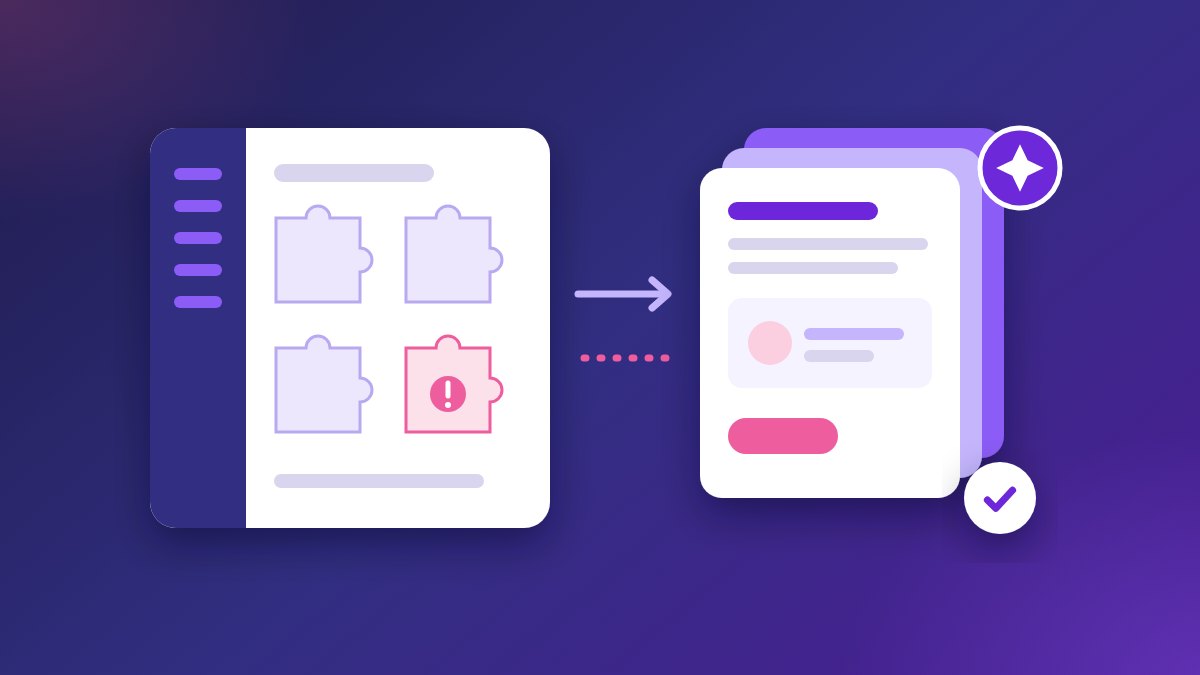
Our own site is built that way.
Is WordPress doing anything about AI?
Yes. WordPress 7.0, released on 20 May 2026, built in a way for WordPress to connect to AI tools, managed from one place in the dashboard you log in to.3 You don’t have to choose between AI and WordPress: WordPress now connects to AI tools too.
Should my business move off WordPress?
Not because of a headline. The software matters less than whether your site does its job. Ask four questions.
- Does it bring in enquiries? If people find you, read it and get in touch, it’s working.
- Is it quick on a phone? If a page is slow to open, people may give up before it does.
- Is it kept up to date? WordPress sites run on plugins, small add-ons that each need updating. If nobody does that, the site gets riskier every month.
- Can you change it without paying someone each time? If a new price or a new photo means an invoice, that’s a cost you can cut.
If the answers are good, keep it. If they’re bad and you’re about to rebuild anyway, that’s the moment to look at the newer way of building, and our guide to what a small business website costs walks through what you’d pay for.
Either way, two things don’t change. Your domain (your web address) and every login should be in your business’s name.
And your site should be easy for AI tools to read. Google says a page needs nothing special to appear in its AI answers, as long as it’s in Google’s index, the list of pages Google has read, and allowed to show in normal results.4 OpenAI recommends that sites let in the program it sends to read websites, so they can show in ChatGPT’s search answers.5
Common questions
Is WordPress still free? The software is: “WordPress is open source software”,6 which means anyone can use and change it without paying a licence fee. You still pay for hosting, which is somewhere for the site to live online, and you may pay for a theme (the design your site wears), plugins and someone to keep them updated.
Can AI build me a website instead? It can draft one. What it can’t do is know your business, so the words still have to come from you, and someone has to check every page before it goes live.
Will moving off WordPress hurt my Google results? It can if it’s done carelessly. Pointing every old web address at its new page is the step that keeps what you’ve built.
If you’d rather hand it over
New Website builds you a site in your brand, written for you, set up so Google and AI tools can read it. If your WordPress site is doing its job, we’ll tell you that instead, and if what you need is different, we scope it and quote it in writing.
Whatever we build is yours. Book a free hour.
Sources and notes
- Verified, read 3 November 2026. W3Techs, "Historical yearly trends in the usage statistics of content management systems" (1 January each year from 2015, and 3 November 2026), and "Usage Statistics and Market Share of WordPress", figures as of 3 November 2026. https://w3techs.com/technologies/history_overview/content_management/all/y and https://w3techs.com/technologies/details/cm-wordpress
- Verified, read 3 November 2026. Joost de Valk, "Do you need a CMS?", joost.blog, published 21 March 2026. https://joost.blog/do-you-need-a-cms/
- Verified, read 3 November 2026. WordPress.org News, "WordPress 7.0 'Armstrong'", published 20 May 2026. https://wordpress.org/news/2026/05/armstrong/
- Verified, read 3 November 2026. Google Search Central, "AI Features and Your Website"; no date shown on the page. https://developers.google.com/search/docs/appearance/ai-features
- Verified, read 3 November 2026. OpenAI, "Overview of OpenAI Crawlers"; no date shown on the page. https://developers.openai.com/api/docs/bots
- Verified, read 3 November 2026. WordPress.org, "About", last modified 22 October 2026. https://wordpress.org/about/
AI news & hype
Costs keep rising: five jobs AI can take off your week
AI won't cut your rent, wages or power bill. It can check supplier bills for price rises, chase invoices, draft quotes and write up meetings, so your hours go further.
Rory McNeil 
AI news & hype
Is a brand refresh worth it? Yes, when your look doesn't match from the van to the website
What a brand refresh is and isn't, the signs a small business needs one, what it covers from the logo to the van, what it takes in time, the sign and trade mark rules to check in NSW, and what AI changes about it.
Rory McNeil 
AI news & hype
Chatbot for small business: what it must never make up
A chatbot answers questions on your website by itself. What it says, your business said, so here's how to make one that answers from your list, says it's a machine and takes details for the rest.
Rory McNeil